There’s something special about a crochet project that makes people stop scrolling and look twice. The Magical Ice Dragon Crochet Beanie Pattern PDF is exactly that kind of project.
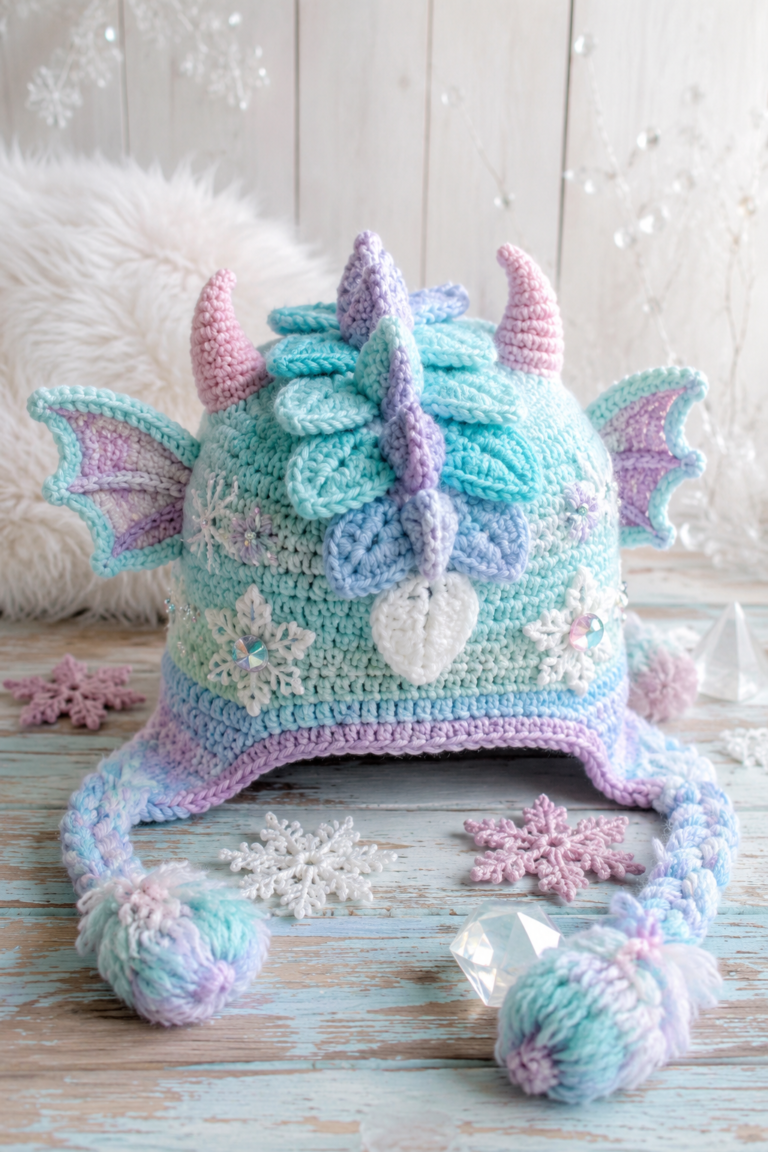
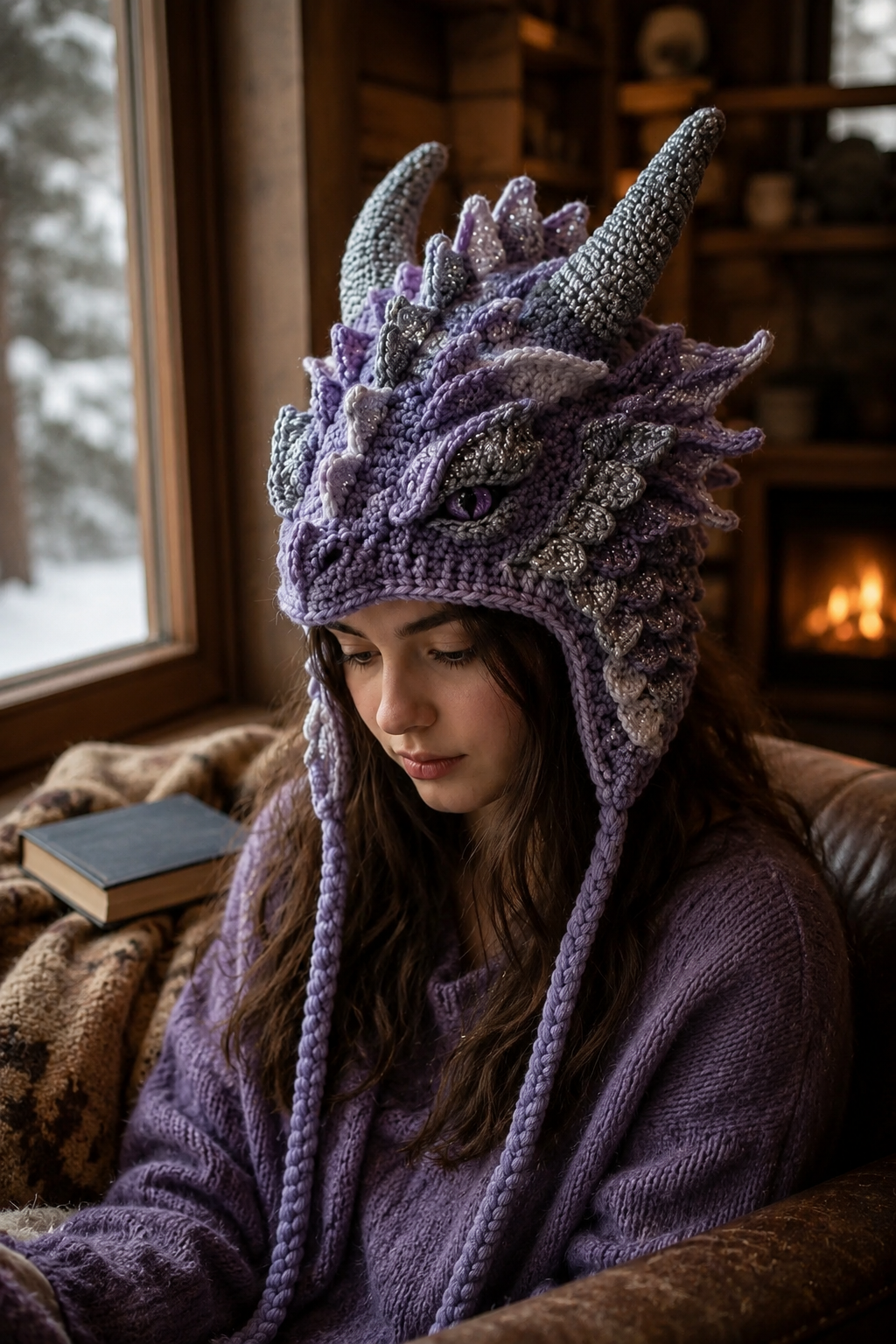
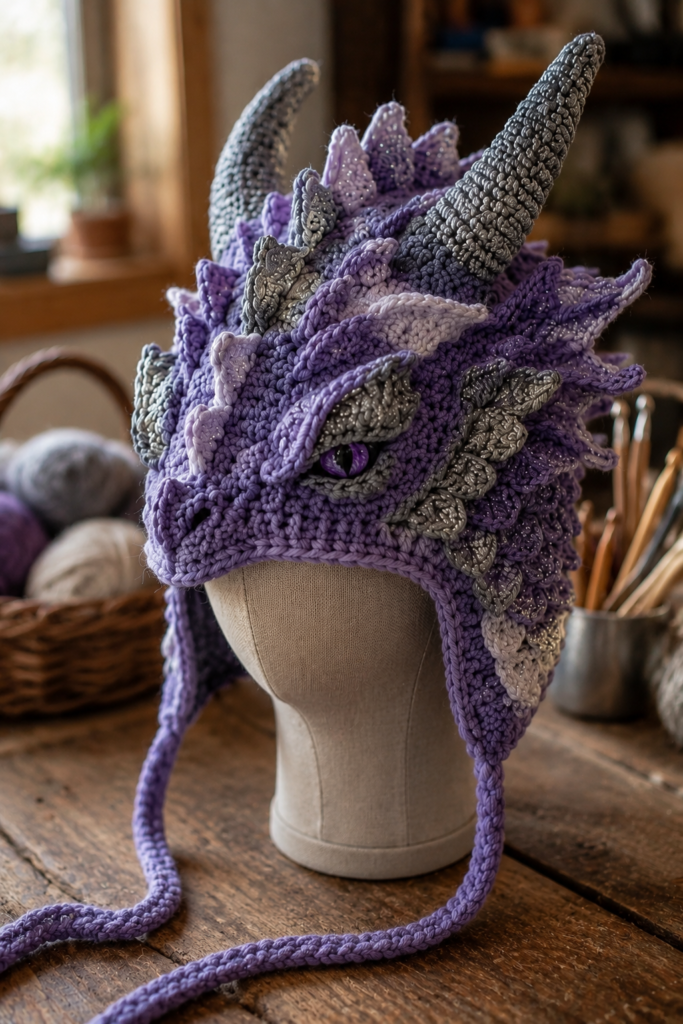
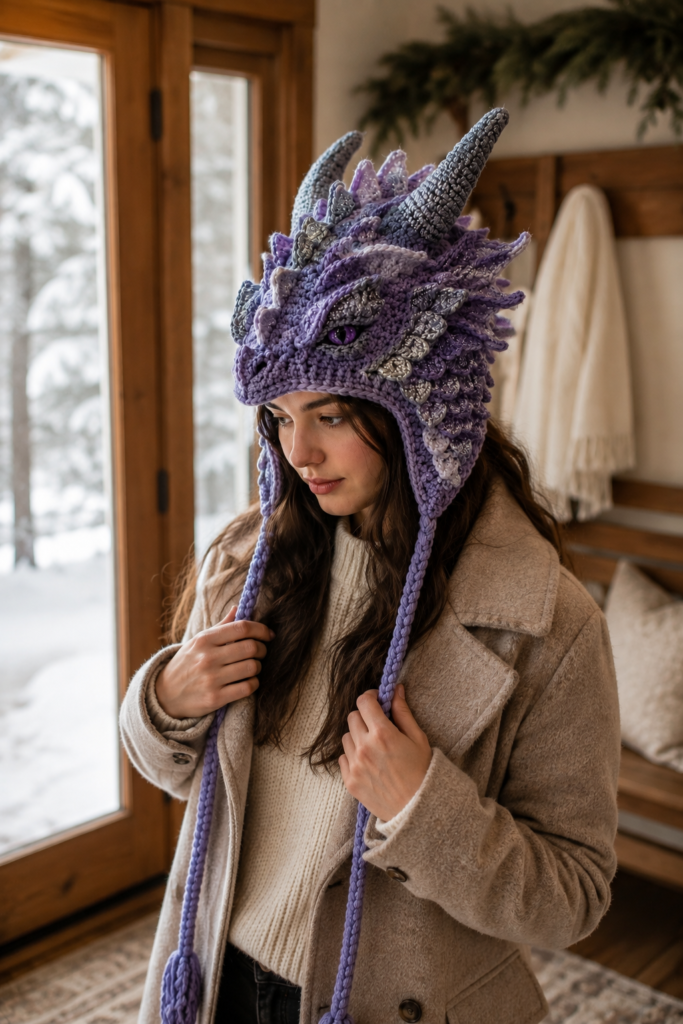
Instead of looking like an ordinary winter hat with a few decorative details added on top, this design transforms the entire beanie into a dramatic fantasy dragon headpiece. The muted lavender base creates a soft, icy foundation, while the large charcoal-gray horns, layered silver and purple scales, sculpted forehead, dragon eyes, pointed side frills, and long crochet ties give the finished piece its unmistakable character.
What makes this project especially interesting from a crocheter’s perspective is the way relatively familiar crochet techniques can be combined to create something highly dimensional. The magic isn’t necessarily in using unusually complicated stitches. It comes from shaping, layering, placement, color selection, and careful finishing.
In this guide, we’ll look at what makes a detailed dragon beanie work, how to choose appropriate materials, what skills are useful before starting, how to approach horns and scales, and how to avoid some of the problems that can make dimensional crochet projects frustrating.
Crochet note: Always use the exact stitch counts, gauge, measurements, yarn requirements, and assembly instructions supplied with your pattern PDF. The guidance below is intended to help you understand and successfully approach this style of project rather than replace the pattern instructions.
Table of Contents
- What Makes This Ice Dragon Beanie Unique?
- Is This Dragon Beanie Beginner Friendly?
- Understanding the Construction
- Choosing the Right Yarn
- Crochet Hooks and Essential Tools
- Getting the Beanie Fit Right
- Creating the Sculpted Dragon Face
- Making Crochet Dragon Horns
- Creating Layered Dragon Scales
- Working on the Dragon Eyes
- Earflaps and Long Crochet Ties
- How to Assemble the Beanie
- Helpful Tips for Beginners
- Time-Saving Crochet Tips
- Common Mistakes and How to Avoid Them
- Caring for Your Finished Dragon Beanie
- Frequently Asked Questions
- Final Thoughts
What Makes the Magical Ice Dragon Crochet Beanie Special?
The first thing that separates this project from a conventional crochet beanie is its silhouette.
A normal beanie depends mainly on color, stitch texture, and perhaps a pom-pom or simple applique for visual interest. A fantasy dragon hat has an entirely different job.
It has to create the recognizable shape of a dragon while still functioning as wearable crochet.
The two tall curved horns establish the strongest part of that silhouette. Around them, smaller spikes and dimensional scales gradually build the dragon’s head.
The forehead extends toward a shaped snout, while raised brows and purple dragon-eye details help create the expression.
Along the sides, overlapping lavender and silver-gray scales create additional depth. The ear-covering sections then transition into long lavender crochet ties.
The color palette creates the ice-dragon effect
Another important feature is the restrained color palette.
Rather than relying on bright blue and white to communicate an icy theme, this dragon uses a more sophisticated combination of:
- Dusty lavender
- Muted purple
- Charcoal gray
- Silver-gray
- Pale lilac
The darker horns provide strong contrast against the lavender base, while lighter scale details prevent the design from becoming visually flat.
This type of tonal palette is particularly effective for dimensional crochet because light and shadow can define the individual pieces.
Is This Dragon Crochet Beanie Beginner Friendly?
A detailed dragon hat can look intimidating.
However, visual complexity doesn’t always mean every individual crochet technique is extremely difficult.
For many crocheters, the biggest challenge will be managing numerous shaped components and assembling them accurately.
A confident advanced beginner who is comfortable reading a crochet pattern may be able to complete a project like this, especially if the pattern provides detailed photographs and clear assembly guidance.
An intermediate crocheter will generally find the process easier.
Skills that will help
Before beginning, it is useful to be comfortable with:
- Chains
- Single crochet
- Half double crochet
- Double crochet
- Working in rounds
- Increasing
- Decreasing
- Working around foundation chains when required
- Counting stitches
- Reading crochet abbreviations
- Sewing crochet components together
- Weaving in ends
- Maintaining consistent tension
You don’t necessarily need to be an expert at all of them.
The important thing is being willing to work slowly and check your progress.
Don’t judge difficulty by appearance alone
One of the most useful lessons in crochet is that complicated-looking projects are often built from simple pieces.
A single scale might be straightforward.
One horn may involve familiar increases and decreases.
An earflap might use stitches you’ve made dozens of times.
The impressive result appears when all those elements are assembled together.
Instead of thinking, I have to crochet an entire dragon, think:
I’ll make one component correctly, then the next.
That mindset makes a detailed project much more manageable.
Understanding the Construction of a Crochet Dragon Beanie
It helps to think of this design as having two main layers.
The first is the wearable foundation.
The second is the dragon sculpture built over that foundation.
The base needs to fit comfortably before the decorative pieces are added.
Depending on the specific pattern, the project may include components such as the main hat, ear sections, ties, large horns, smaller spikes, forehead details, snout shaping, brows, eye surrounds, cheek scales, temple scales, and side frills.
Not every pattern constructs these elements in exactly the same way.
That is why reading through your complete pattern before starting is important.
Why separate components work so well
Crocheting many decorative elements separately provides greater control over the finished shape.
Imagine trying to build every scale directly into the hat as you crochet it. Placement and shaping would become difficult very quickly.
Separate pieces allow you to make a component, examine it, reshape it if necessary, and then position it precisely before sewing.
It also makes symmetrical construction easier because you can compare matching pieces before attaching them.
Choosing the Right Yarn for a Dragon Beanie
Yarn selection matters enormously for a project this detailed.
You’re looking for a balance between three characteristics:
comfort, structure, and stitch definition.
A yarn that is extremely stiff may create excellent horns but feel uncomfortable around the forehead.
A very soft, fuzzy yarn might feel wonderful but hide all the carefully constructed scales.
Prioritize stitch definition
For sculptural crochet, individual stitches should remain visible.
Smooth yarns generally show dimensional details better than highly fuzzy fibers.
The yarn weight specified in your pattern should be your starting point. Changing yarn weight can alter almost every measurement in the project.
A thicker yarn can produce:
- A larger hat
- Bulkier scales
- Wider horns
- A heavier finished piece
A thinner yarn can do the opposite.
For your first version, staying close to the recommended yarn weight is usually the safest approach.
Fiber considerations
Acrylic yarn is practical for fantasy crochet because it is widely available, relatively affordable, and offered in many colors.
Wool can provide warmth, resilience, and beautiful stitch definition, although washing requirements may be more demanding.
Acrylic-wool blends can offer a useful middle ground.
Whatever you choose, remember that the hat will touch the forehead and possibly the cheeks.
Test the yarn against your skin before committing to the entire project.
Crochet Hooks and Essential Tools
Use the crochet hook recommended by your pattern as the starting point.
But don’t treat the hook number as a guarantee of finished size.
Your personal tension matters.
Two people can use identical yarn and identical hooks and still create different-sized pieces.
That’s why gauge is important.
Helpful tools to keep nearby
In addition to your yarn and crochet hook, you may find these useful:
- Locking stitch markers
- Yarn needle
- Sharp scissors
- Flexible measuring tape
- Straight or safety pins for positioning
- Row counter
- Small containers for completed pieces
- Stuffing, if required by the pattern
Stitch markers are particularly valuable when working on horns or other pieces in continuous rounds.
Mark the first stitch of each round rather than relying on memory.
Getting the Beanie Fit Right
The decorative dragon details may be the exciting part, but the base deserves just as much attention.
A beautifully constructed dragon headpiece that doesn’t fit properly won’t be enjoyable to wear.
Measure the intended wearer’s head circumference and compare it with the sizing information in the pattern.
Gauge matters more than many crocheters expect
A small difference in stitch size can multiply across an entire hat.
If your stitches are consistently larger than the designer’s, your finished circumference may also be larger.
Make a gauge swatch whenever the pattern recommends one.
It can feel like an unnecessary delay when you’re excited to begin, but it may save hours of reworking later.
Try on the base first
Before attaching a large number of decorative pieces, check the fit.
Pay attention to:
- Forehead position
- Circumference
- Depth
- Ear coverage
- Back-of-head coverage
- Comfort around the face
If something needs correcting, this is the best time to do it.
Creating the Sculpted Dragon Face
The face gives this beanie its personality.
The reference design doesn’t simply place eyes onto a flat hat. Multiple crochet elements work together to suggest the forehead, brows, snout, cheeks, and armored facial structure of a fantasy dragon.
This is where accurate placement becomes especially important.
Find the center first
Before sewing anything permanently, identify the center front of the beanie.
You can place a removable stitch marker there.
Use that center line as the reference point for surrounding facial pieces.
Working outward from the center helps prevent the face from slowly drifting toward one side.
Don’t rely only on close-up inspection
When you’re sewing, you’re naturally looking at the hat from a very short distance.
That is useful for checking individual stitches but not always for evaluating overall proportions.
Every so often, put the hat on a head form or suitable model and move several feet away.
Look at it from:
- Straight ahead
- Left three-quarter view
- Right three-quarter view
- Side profile
A smartphone photograph can also reveal alignment problems surprisingly well.
Making Strong Crochet Dragon Horns
The large charcoal and silver-gray horns are among the most important features of this ice dragon design.
They establish height and create the dramatic fantasy silhouette.
Good horns need to achieve several things simultaneously.
They should be defined, relatively lightweight, consistent with each other, and securely attached.
Keep your tension consistent
If one horn is worked with loose tension and the second with tight tension, their finished shapes can differ even when the stitch counts are identical.
Try making both horns during the same stage of the project.
Add stuffing gradually when required
If the pattern uses stuffed horns, don’t wait until the very end and force a large amount of fiberfill inside.
Add small amounts progressively.
This gives you more control over the shape.
Overstuffing can stretch the stitches, create visible gaps, and make the horns unnecessarily heavy.
Shape the curve carefully
For curved horns, the direction of the bend is important.
Before attachment, compare both horns on a flat surface.
Check the:
- Length
- Base circumference
- Tip shape
- Curve
- Stuffing density
Small handmade differences are normal.
What you’re trying to avoid is an obvious mismatch.
Creating Beautiful Layered Dragon Scales
The scales are one of the most satisfying elements of this project because they create so much visual depth.
The lavender and silver-gray layers overlap around the forehead and sides, producing a natural armored appearance.
Consistency is more important than perfection
Handmade scales won’t be identical down to the millimeter.
They don’t need to be.
But repeated components should belong to the same visual family.
If your tension changes significantly halfway through, later scales may become noticeably different.
For repeated pieces, consider crocheting several in the same session.
Don’t automatically flatten every scale
Dimensional crochet depends on depth.
If every decorative piece is sewn completely flat against the hat, some of the sculptural effect can disappear.
Follow the pattern’s recommended attachment points.
Some scale tips may naturally lift slightly from the surface, creating shadows between layers.
That can be a feature rather than a mistake.
Getting the Dragon Eyes Right
The purple eye detail is small compared with the horns, but it has a huge influence on the final expression.
Eye placement can make a dragon look fierce, sleepy, friendly, surprised, or uneven.
Before permanently securing the eye area, temporarily position both sides and examine the face from the front.
Check the brows too
Sometimes an eye appears crooked even when the eye itself is positioned correctly.
The real problem may be the brow or surrounding scale.
Evaluate the entire eye area as one unit.
Look at the distance from each eye to:
- The center snout
- The nearest horn
- The forehead center
- The side scales
This is much more reliable than judging each eye independently.
Earflaps and Long Crochet Ties
The long lavender ties contribute more to the design than you might initially think.
The horns create strong upward movement.
The ties counterbalance that visually by extending downward.
They also emphasize that this dramatic dragon sculpture is still a wearable winter accessory.
Keep both sides consistent
Use the same method and tension for both ties.
If they’re braided or twisted, count strands and turns carefully.
If they’re crocheted cords, compare their lengths before finishing.
Put the hat on a form afterward and allow both ties to hang naturally.
Don’t stretch one while measuring and leave the other relaxed.
How to Assemble Your Dragon Beanie Successfully
Assembly is where patience pays off.
Avoid the temptation to sew each piece immediately after finishing it.
Instead, complete several major components first so you can see how they interact.
Start with the largest visual landmarks
Depending on your pattern’s specified assembly order, it can be helpful to temporarily position major components such as the central face structure and horns before committing to secondary scales.
Once the primary structure looks balanced, the smaller details become easier to place.
Pin first, sew second
This is one of the most valuable habits for dimensional crochet.
Pin components temporarily.
Look at the hat.
Adjust them.
Look again.
Only start permanent sewing when you’re satisfied.
Ten minutes spent repositioning pieces can prevent an hour of unpicking seams.
Secure high-stress areas carefully
Horns and larger raised elements experience more movement than flat appliques.
Use the attachment method recommended by the pattern and make sure the base is secure.
The goal is a stable attachment without pulling the underlying hat fabric into an unnatural shape.
Beginner Tips for a Detailed Fantasy Crochet Project
A complicated-looking project becomes much easier when you organize it.
Don’t place every yarn ball, scale, needle, marker, and finished component in one pile.
Keep finished pieces grouped.
If multiple scales are similar, label them.
You can use small pieces of paper or removable markers.
Work in stages
A practical workflow is:
Stage 1: Read the complete pattern.
Stage 2: Check yarn, hook, gauge, and sizing.
Stage 3: Complete the wearable base.
Stage 4: Test the fit.
Stage 5: Crochet large paired components.
Stage 6: Crochet smaller scales and details.
Stage 7: Temporarily position everything.
Stage 8: Assemble carefully.
Stage 9: Weave in remaining ends and perform a final inspection.
This makes the project feel much less overwhelming.
Time-Saving Tips That Don’t Sacrifice Quality
Saving time in crochet shouldn’t mean rushing your stitches.
The best time-saving techniques prevent mistakes.
Count regularly
Don’t assume a round is correct because it looks right.
A missed increase can affect several later rounds.
Check stitch counts at the points specified by your pattern.
Make repeated pieces together
If you need several similar scales, complete them consecutively.
You won’t have to repeatedly relearn the same instructions.
Leave useful yarn tails
When the pattern asks you to leave a long tail for sewing, do it.
A properly sized tail can save you from joining additional yarn later and may create cleaner attachment points.
Take progress photos
Photographs aren’t only for social media.
Take a straight-on photograph before permanently sewing the facial components.
Mirroring or simply viewing the photograph on another screen can make asymmetry easier to notice.
Common Mistakes and How to Avoid Them
Mistake 1: Skipping the gauge check
This is especially risky for a wearable.
Solution: Make the recommended gauge swatch and adjust your hook if necessary.
Mistake 2: Using yarn that hides the stitches
Very fuzzy fibers can blur scale definition.
Solution: Choose yarn with enough stitch clarity to show sculptural details.
Mistake 3: Overstuffing the horns
This can stretch stitches and make the horns heavy.
Solution: Add small amounts of stuffing gradually when stuffing is required.
Mistake 4: Attaching components without checking symmetry
A few millimeters can become visually significant around the eyes and horns.
Solution: Pin components and inspect the hat from several angles before sewing.
Mistake 5: Changing yarn weight casually
This can alter the fit of both the beanie and decorative components.
Solution: Stay close to the yarn specifications unless you’re comfortable recalculating size and gauge.
Mistake 6: Sewing every decorative piece completely flat
That can reduce the dimensional scale effect.
Solution: Follow the pattern’s attachment instructions and preserve intentional layering.
Mistake 7: Rushing the final assembly
Crocheting may be finished, but the project isn’t.
Solution: Treat assembly as its own important stage.
Choosing Colors for an Ice Dragon Look
The lavender-gray palette is one of the strongest elements of this design.
If you’re trying to preserve the same magical ice-dragon character, look for colors with relatively cool undertones.
A dusty lavender makes an excellent foundation.
Charcoal creates strong horn contrast.
Silver-gray adds a frosted armored quality, while pale lilac helps separate overlapping scale layers.
Try placing yarn skeins beside one another before buying or beginning.
Photograph them in daylight if possible.
Colors that look perfectly coordinated under warm store lighting can look surprisingly different beside a window.
Caring for Your Finished Crochet Dragon Beanie
A highly dimensional crochet hat deserves more careful treatment than a basic beanie.
Start with the care instructions printed on the yarn label.
Fiber content determines what washing methods are appropriate.
When in doubt, and when compatible with the yarn, gentle hand washing is often easier on sculptural crochet than aggressive machine washing.
Avoid wringing or twisting the hat.
Instead, gently remove excess water and reshape the piece.
Pay particular attention to the horns and scales while drying.
Dry it in shape
Don’t leave a wet dimensional hat crushed into a pile.
Arrange the horns, brows, scales, and ear sections into their intended positions before drying.
Allow the piece to dry thoroughly.
Store it without crushing the horns
Storage is particularly important for this design.
Don’t place heavy sweaters, blankets, or other objects on top of the horns.
Give the beanie enough space to maintain its silhouette.
If you’re storing it for an entire season, make sure it is completely clean and dry first.
Styling a Magical Ice Dragon Crochet Beanie
A headpiece this detailed doesn’t require complicated styling.
In fact, simple clothing usually works best because it allows the crochet craftsmanship to remain the focus.
Neutral winter coats, cream knits, charcoal layers, or muted purple sweaters can complement the lavender and silver palette without competing with it.
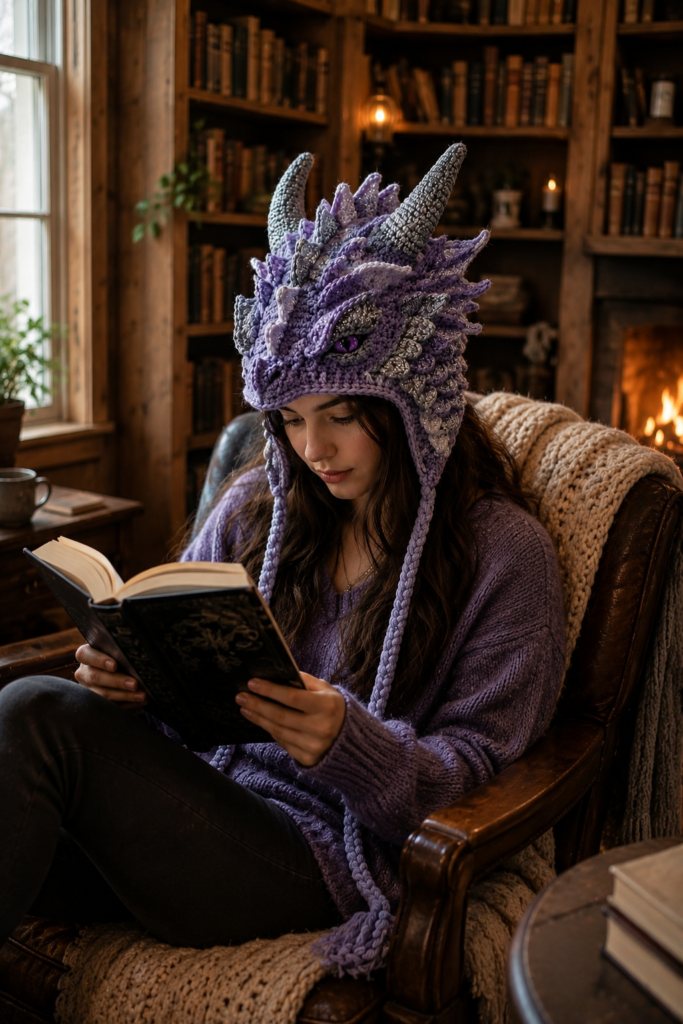
The beanie also works beautifully in cozy settings such as a reading nook, cabin, winter porch, fantasy-themed event, handmade market display, or seasonal photoshoot.
The dimensional silhouette does most of the visual work.
Frequently Asked Questions
What is a Magical Ice Dragon Crochet Beanie?
A magical ice dragon crochet beanie is a fantasy-inspired wearable crochet hat designed with dimensional dragon features such as sculpted horns, layered scales, facial shaping, eye details, ear-covering sections, and decorative ties. An ice-dragon palette commonly uses cool colors such as lavender, silver, gray, and purple.
Is the Magical Ice Dragon Crochet Beanie Pattern PDF suitable for beginners?
It is more appropriate for a confident advanced beginner or intermediate crocheter than someone making their very first crochet project. The individual techniques may be manageable, but accurate shaping and assembly require patience.
What yarn should I use for a crochet dragon beanie?
Use the yarn weight specified by your pattern. A smooth yarn with good stitch definition is especially helpful for showing detailed scales, brows, and horns.
Can I make the dragon beanie in another color?
Yes. Color changes are generally much easier than structural modifications. If you want to retain the icy character, cool lavender, silver-gray, charcoal, icy blue, or pale lilac can work well together.
How can I make crochet horns stand properly?
Follow the pattern’s gauge and construction instructions carefully. If stuffing is required, add it gradually and avoid overstuffing. A secure attachment at the horn base is also essential.
How do I make both crochet horns the same size?
Use the same yarn, hook, tension, stitch counts, and stuffing amount for both. Make them during the same stage of the project and compare them before attachment.
Why are my crochet scales curling?
Some curling may be intentional in dimensional scale designs. If the piece is curling much more than expected, check your tension, stitch counts, hook size, and the pattern’s intended shaping.
Should crochet dragon scales lie flat?
Not necessarily. Slightly raised or overlapping scales can create the depth that makes a dragon design convincing. Follow the pattern’s specific attachment instructions.
How do I make sure the dragon’s face is symmetrical?
Mark the center front of the hat, temporarily pin the facial pieces, and inspect the project from a distance before permanent attachment. Taking a front-facing photograph can also help reveal alignment problems.
How long does a detailed dragon crochet beanie take?
It depends heavily on experience, pattern complexity, and the number of components. A sculptural dragon hat generally takes significantly longer than a basic beanie, so planning several crochet sessions is more realistic than trying to finish it quickly.
Can I resize a crochet dragon beanie?
Potentially, but resizing a detailed wearable can affect the placement and proportions of every decorative component. Follow the sizing instructions supplied by the pattern rather than simply changing hook size unless you understand how the adjustment will affect the complete project.
How should I wash a dragon crochet hat?
Follow the yarn manufacturer’s care instructions. For highly dimensional pieces, gentle washing and careful reshaping during drying can help protect the horns and scales.
Why This Is Such a Rewarding Crochet Project
Detailed fantasy crochet gives you an opportunity to use familiar skills in an entirely different way.
You’re not just producing fabric.
You’re using stitches to create structure.
The horns demonstrate shaping. The scales demonstrate repetition and layering. The face relies on careful placement. The beanie itself requires attention to gauge and wearable fit.
When those elements come together successfully, the finished project can look far more complicated than the techniques used to build it.
And that’s one of the most satisfying experiences in crochet.
Final Thoughts
The Magical Ice Dragon Crochet Beanie Pattern PDF style is a wonderful example of how far dimensional crochet can go beyond traditional hats.
Its dusty lavender base provides a soft foundation, while the dramatic charcoal and silver-gray horns create the unmistakable dragon silhouette. Layered scales bring depth to the sides and crown, and the sculpted snout, brows, purple eye details, earflaps, and long crochet ties complete the fantasy character.
For the best result, don’t rush.
Start with accurate gauge and a comfortable base. Make matching components carefully. Check your horns before attachment. Keep your scales organized. Most importantly, temporarily position the dragon’s facial features before permanently sewing them.
The individual stitches create the pieces, but careful assembly is what brings the dragon to life.
If you enjoy projects that combine wearable crochet with detailed fantasy design, save this idea for your project list and explore more crochet patterns, beginner-friendly guides, and handmade inspiration from Stitch Nest Studio Shop for your next make.